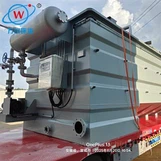
A suspended air flotation system is a highly effective solution for wastewater treatment, which uses micro - bubbles to separate suspended solids, oils, and other contaminants from water. As a supplier of suspended air flotation systems, I'm here to guide you through the installation process.
1. Pre - installation Preparations
Before you start the installation, a series of preparations are necessary. First, you need to select an appropriate installation site. The site should be flat, with enough space to accommodate the entire system and provide easy access for operation and maintenance. It's also crucial to ensure that the site is close to the wastewater source and the treated water discharge point to minimize the length of the pipeline, thus reducing energy consumption and potential leakage risks.
Next, you should conduct a thorough inspection of all the components of the suspended air flotation system. Check for any visible damage during transportation, such as cracks in the tank, loose connections in the pipes, or malfunctioning electrical components. Make sure that all the necessary parts are included according to the system manual.
It's also important to review the local regulations and permits related to the installation and operation of the wastewater treatment system. Different regions may have specific requirements regarding environmental protection, safety, and construction standards. Obtaining the necessary approvals in advance can prevent potential legal issues during and after the installation.
2. Foundation Construction
The foundation is the base of the suspended air flotation system, which provides stable support for the entire equipment. The type of foundation depends on the size and weight of the system, as well as the geological conditions of the installation site.
For small - scale systems, a simple concrete slab foundation may be sufficient. The concrete should be of high - quality, with a proper mix ratio to ensure its strength and durability. The thickness of the slab usually ranges from 150mm to 300mm, depending on the load. During the construction of the concrete slab, pay attention to the flatness. The allowable deviation of the flatness should be within a very small range, usually no more than ±5mm per square meter.
For large - scale systems, a more complex foundation design may be required, such as a pile foundation. Pile foundations are suitable for soft soil conditions, where the soil cannot provide enough bearing capacity for the heavy equipment. Professional geotechnical engineers should be involved in the design and construction of pile foundations to ensure their safety and reliability.
3. Installation of the Main Tank
Once the foundation is ready, the main tank of the suspended air flotation system can be installed. The main tank is the core part of the system, where the separation of contaminants takes place.
First, carefully lift the main tank onto the foundation using appropriate lifting equipment, such as a crane. Ensure that the tank is placed accurately on the foundation, aligning it with the pre - marked position. Then, use anchor bolts to fix the tank to the foundation. The anchor bolts should be tightened evenly to prevent uneven stress on the tank.
After the tank is fixed, connect the inlet and outlet pipes. The inlet pipe is used to introduce the wastewater into the tank, while the outlet pipe is for discharging the treated water. Make sure that the pipe connections are tight and leak - free. You can use sealing gaskets and appropriate pipe joints to ensure the quality of the connections.
4. Installation of the Micro Bubble Generator
The micro bubble generator is a key component of the suspended air flotation system, which generates a large number of micro - bubbles to attach to the contaminants and float them to the surface.
Install the micro bubble generator in the appropriate position inside the main tank. Follow the manufacturer's instructions to ensure the correct installation height and orientation. Connect the air supply pipe and the water supply pipe to the micro bubble generator. The air supply pipe provides compressed air to the generator, while the water supply pipe supplies water for the generation of micro - bubbles.
Check the connection of the electrical wiring of the micro bubble generator. Ensure that the wiring is correct and that the electrical insulation is good to prevent electrical accidents. After the installation, test the micro bubble generator to ensure that it can generate micro - bubbles with the required size and quantity.
5. Installation of the Skimming Device
The skimming device is used to remove the floating contaminants from the surface of the water in the main tank.


Install the skimming device at the top of the main tank. Adjust its position and height to ensure that it can effectively skim the floating layer. Connect the skimming device to the collection tank or the discharge pipe. The collection tank is used to collect the removed contaminants, which can be further processed or disposed of.
Make sure that the skimming device can operate smoothly. Check the movement of the skimming blade or the belt, and adjust the speed and angle according to the actual situation. Lubricate the moving parts regularly to reduce friction and wear.
6. Installation of the Control System
The control system is responsible for the overall operation and monitoring of the suspended air flotation system.
Install the control panel in a convenient location, such as near the main tank or in the control room. Connect all the electrical components of the system, including the micro bubble generator, the skimming device, the pumps, and the valves, to the control panel.
Program the control system according to the specific requirements of the wastewater treatment process. Set the operating parameters, such as the start - stop time, the flow rate, the air - water ratio, etc. The control system should be able to automatically adjust the operation of the system based on the real - time data of the water quality and the equipment status.
7. Pipeline Installation and Connection
In addition to the pipes connected to the main tank and the components mentioned above, there are also other pipelines in the system, such as the chemical dosing pipeline and the sludge discharge pipeline.
Install the chemical dosing pipeline to introduce chemicals, such as flocculants and coagulants, into the system. The chemicals can improve the separation effect of the contaminants. Connect the chemical dosing pipeline to the appropriate position in the main tank or the inlet pipe. Make sure that the dosing equipment can accurately control the dosage of the chemicals.
The sludge discharge pipeline is used to remove the settled sludge from the bottom of the main tank. Install the sludge discharge pipeline at the bottom of the tank and connect it to the sludge treatment equipment or the storage tank. Ensure that the pipeline has a proper slope to facilitate the smooth flow of the sludge.
8. Testing and Commissioning
After the installation is completed, a series of tests and commissioning work are required to ensure the normal operation of the suspended air flotation system.
First, conduct a pressure test on all the pipelines to check for any leaks. Use a pressure gauge to monitor the pressure during the test. The test pressure should be higher than the normal operating pressure to ensure the safety of the pipelines.
Then, perform a trial run of the system. Start the pumps, the micro bubble generator, the skimming device, and other equipment one by one. Observe the operation of the system, including the generation of micro - bubbles, the skimming effect, and the flow of water and sludge. Check the water quality of the inlet and outlet to evaluate the treatment effect of the system.
During the commissioning process, adjust the operating parameters of the system according to the test results. Optimize the air - water ratio, the chemical dosage, and the skimming speed to achieve the best treatment effect.
9. Maintenance and Support
Once the suspended air flotation system is put into operation, regular maintenance is essential to ensure its long - term stable operation.
Establish a maintenance plan, including regular inspection of the equipment, cleaning of the components, replacement of the wearing parts, and calibration of the instruments. Train the operators to ensure that they can correctly operate and maintain the system.
As a supplier, we provide comprehensive after - sales service and technical support. If you encounter any problems during the installation, operation, or maintenance of the system, you can contact us at any time. We have a professional technical team that can provide on - site support and solutions to ensure the normal operation of your system.
If you are interested in our suspended air flotation systems or need more detailed information about the installation process, please feel free to contact us for procurement and further discussions. We are committed to providing high - quality products and services to meet your wastewater treatment needs.
References
- Wastewater Treatment Engineering Handbook, Second Edition, edited by Metcalf & Eddy
- Principles and Practices of Water Supply Operations: Water Quality and Treatment, Fourth Edition, American Water Works Association